Skip to content

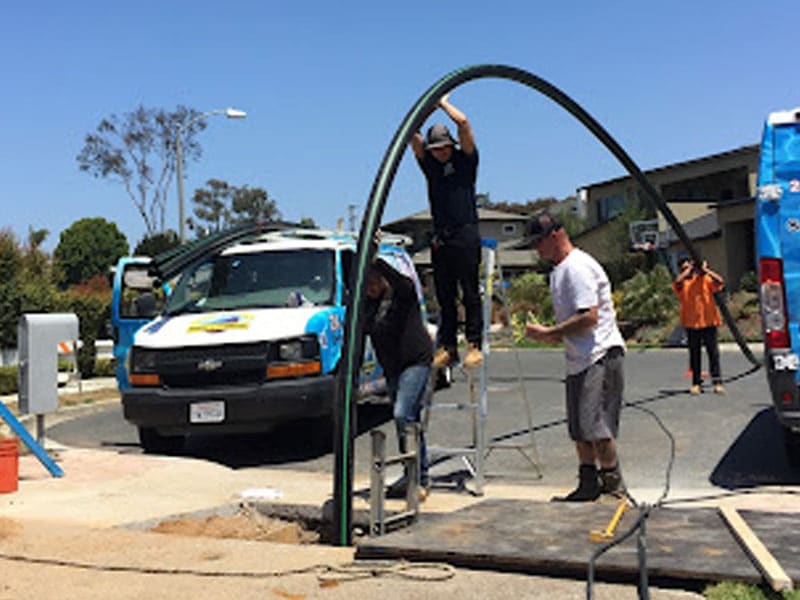
Trenchless sewer replacement changed sewer line work for San Diego homeowners. The old approach — digging a long trench across your yard from the house to the city main, replacing the line section by section, then rebuilding the yard — was disruptive, expensive, and brutal on mature landscaping. Trenchless methods accomplish the same outcome with two small access points and minimal yard disruption. Here’s what it actually involves and when it works.
The Two Main Trenchless Methods
“Trenchless” is a category, not a single technique. Two methods dominate residential work:
- Pipe Lining (Cured-in-Place Pipe / CIPP): a flexible liner saturated with resin is pulled through the existing pipe, inflated to press against the inside walls, then cured (heat or UV) to form a new pipe inside the old one. Reduces interior diameter slightly but works for most residential sewer lines.
- Pipe Bursting: a bursting head is pulled through the existing pipe, fracturing the old pipe outward while simultaneously pulling a new HDPE pipe into place behind it. Maintains or increases pipe diameter. Requires the old pipe to be soft enough to break.
Both methods need only two access points — typically one near the house cleanout and one at the city main connection. No long trench across the yard.
When Trenchless Works (And When It Doesn’t)
Trenchless requires the existing pipe path to be largely intact. Camera inspection determines viability before any quote is meaningful. Trenchless works when:
- The pipe is cracked or has root intrusion but the overall path is continuous
- The pipe material is suitable (clay, cast iron, PVC, even some Orangeburg if intact enough for bursting)
- The line has limited “bellies” (sagging sections where waste pools)
- The diameter is consistent (no sudden transitions that prevent the liner from pulling through)
Trenchless does NOT work when:
- The line is fully collapsed in sections
- The line has severe bellies that need re-grading (those require excavation to fix)
- The pipe has been crushed by tree roots or settling
- The line has had previous failed repair attempts that compromise structural integrity
Why San Diego Homeowners Choose Trenchless More Often Than They Used To
Three factors push San Diego sewer work toward trenchless:
- Mature landscaping: a 40-year-old jacaranda in your front yard is irreplaceable. Trenchless preserves it.
- Hardscape: driveways, patios, pool decks — open-trench repair means tearing through and rebuilding all of it
- HOA restrictions: many San Diego HOAs restrict excavation and landscaping changes — trenchless avoids triggering most of those restrictions
- Faster turnaround: trenchless takes 1-3 days vs 5-10 for traditional
What the Process Actually Looks Like
A typical trenchless replacement timeline:
- Day 1 morning: camera inspection, locate the pipe path, mark access points
- Day 1 afternoon: excavate two access points (typically 3-4 ft deep, 2-3 ft wide each)
- Day 2 morning: clean and prep the existing pipe (jetting if needed, removing roots)
- Day 2 afternoon: install the liner or burst-pull the new pipe
- Day 3 morning: cure (for CIPP) or test the new line
- Day 3 afternoon: backfill access points, restore surface
Water service stays on throughout. Sewer service is temporarily disrupted (12-24 hours typical) — plan around that.
Cost Reality
Trenchless is more expensive per linear foot than open-trench because of the equipment and resin involved. But the total cost is usually LOWER because the savings on landscaping restoration, hardscape repair, and permitting more than offset the higher per-foot rate. The EPA’s sustainable water infrastructure guidance includes trenchless among the recommended methods for residential sewer replacement.
The math gets significantly worse for traditional excavation when you factor in:
- Tree removal and replanting
- Driveway repair (concrete cut, replace, cure)
- Patio rebuild
- Sprinkler/irrigation repair
- Sod or landscaping replacement
- City permit + inspection for the larger excavation
When Multiple Trades Need to Coordinate
Major sewer work in older neighborhoods often surfaces other issues at the same time — corroded gas lines, water supply lines that need updating, electrical conduit that’s in the way. Coordinating these makes the project go smoother. For HVAC ductwork re-routing during major plumbing work, specialized contractors handle that coordination in their market. And for water-damage restoration that sometimes follows a sewer backup, professional cleanup services cover that scope for property owners in their area.
Questions to Ask the Trenchless Contractor
- Show me the camera footage that’s driving this recommendation
- What’s the pipe material being installed and what’s its expected lifespan?
- Is the liner material NSF-certified for potable adjacent installations?
- What warranty comes with the work, and is it transferable to a future homeowner?
- Will you pull the permit, or am I responsible?
- What happens if you encounter unexpected issues during the work?
Your San Diego Trenchless Sewer Replacement Specialists
Blue Planet Drains & Plumbing runs both pipe lining and pipe bursting trenchless sewer replacement across San Diego County — Chula Vista, San Diego, Bonita, Coronado, La Jolla, Del Mar, Carlsbad, Oceanside, Poway, and surrounding communities. Our trenchless sewer replacement service includes the upfront camera inspection that determines whether trenchless is the right call for your specific pipe. Contact us for an honest assessment before committing to any sewer replacement quote.
Request Service
For the method-by-method detail, see trenchless pipe lining and pipe bursting in San Diego.