Skip to content

The two no-dig methods, compared
Trenchless Pipe Lining and Pipe Bursting in San Diego, CA
Lining rebuilds the pipe you have. Bursting replaces it with a new one. Which one your lateral needs is a camera question.
Trenchless work comes in two forms and they are not interchangeable. Pipe lining cures a new pipe inside the old one, so the existing line has to be structurally continuous. Pipe bursting pulls a new pipe through while fracturing the old one outward, so it works where the original has collapsed and it can increase the diameter. Blue Planet Plumbing uses both across San Diego County, and the camera decides which.
Pipe lining: rebuilding the pipe from the inside
Lining, sometimes called cured-in-place pipe, means drawing a resin-saturated liner through the host pipe, inflating it against the wall and curing it. What you end up with is a continuous jointless pipe formed inside the old one, with no open joints for roots to enter and no offsets to catch solids.
The requirement is that the host pipe still has to be there. Lining follows the shape it is given, so a line that is intact but cracked, root-infested at the joints, or corroded internally is an excellent candidate. A line that has collapsed, or one with a section missing, is not — there is nothing to line against.
It also costs a little diameter. On a lateral that was adequately sized to begin with that is not an issue; on one that was already marginal, it is worth knowing before rather than after.
Pipe bursting: replacing without a trench
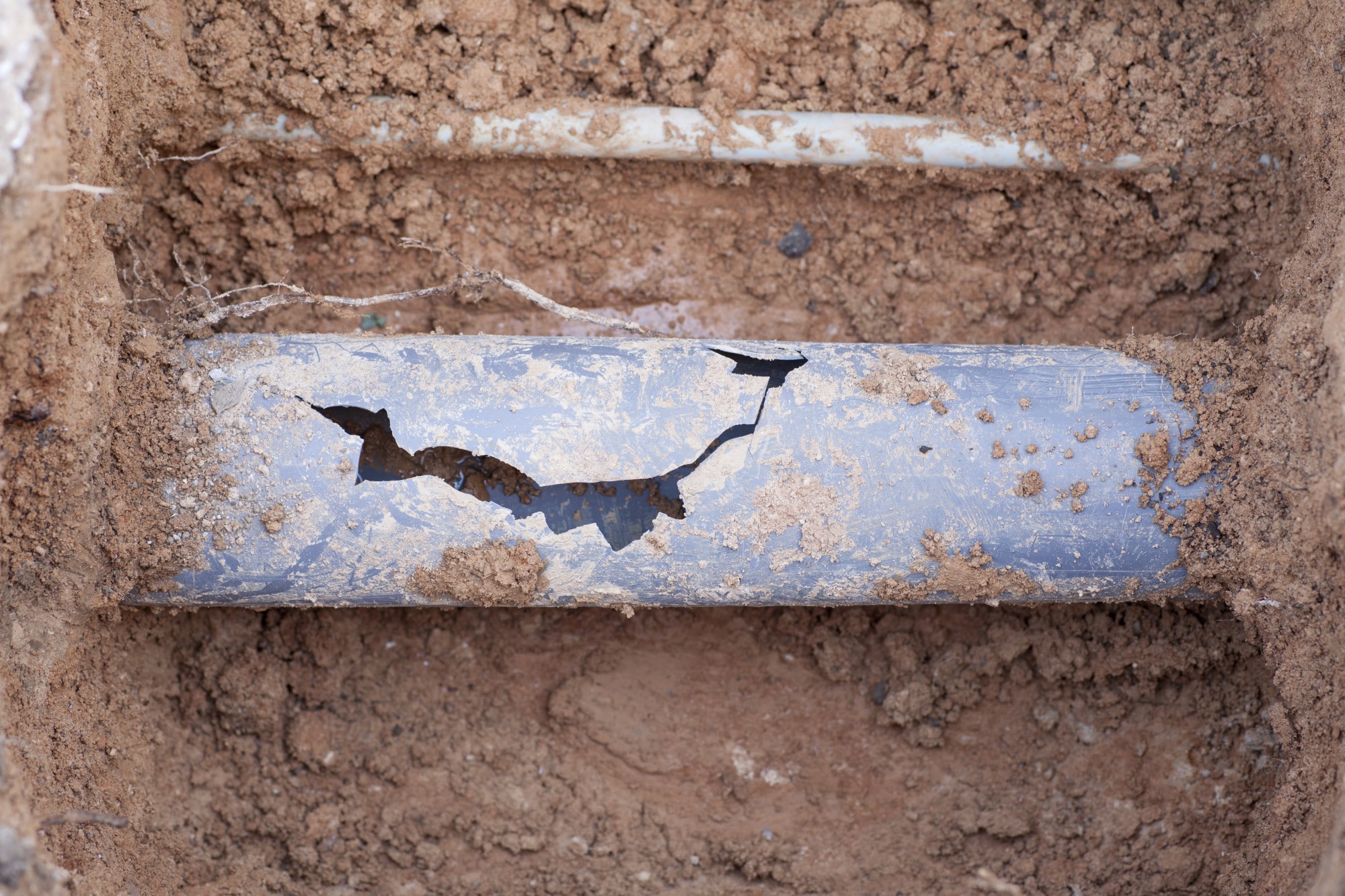
Bursting works the opposite way round. A bursting head is pulled through the old line on a cable; it fractures the original pipe outward into the surrounding soil and drags the new pipe in behind it. The old pipe is not reused, it is displaced.
That makes bursting the method for lines that have failed structurally — collapsed sections, badly offset joints, a lateral that has sagged. It is also the method when the new line needs to be larger than the old one, because you are not constrained by the existing bore.
The trade-off is access. Bursting needs a pit at each end to launch and receive, so it is not trench-free, it is trench-minimal. What it avoids is opening the whole run across a driveway, a mature garden or a finished patio.
How we decide between them
With a camera, before anything else. The footage tells us whether the host pipe is continuous, where the joints have opened, whether roots are through, whether a section is bellied or missing, and what the material is. That is the whole decision.
Continuous but degraded points to lining. Collapsed, badly offset or needing an upsize points to bursting. Where the fault is a single short defect and the rest of the line is sound, neither may be right — a spot repair is cheaper and less disruptive than treating the whole run, and our sewer line repair and replacement page covers that option.
Our sewer line camera inspection page explains what we look for and why we record it.
Where trenchless earns its keep in San Diego
The value of a no-dig method is proportional to what is on top of the pipe. A lateral running under a lawn is cheap to open. A lateral running under a driveway, a mature garden, a paved courtyard or a slab is a different proposition, and that is where trenchless stops being a preference and starts being the sensible choice.
Our project log includes trenchless sewer line replacement in Chula Vista, trenchless sewer replacement in Bonita, trenchless sewer main line replacement in San Diego, and trenchless pipe replacement in La Jolla, plus trenchless sewer replacement in Spring Valley.
We also publish city-specific trenchless pages for Chula Vista, National City, El Cajon, La Mesa, Alpine, Coronado, Imperial Beach, Bonita, Lemon Grove, Spring Valley and Rancho San Diego. The main service page is trenchless sewer replacement.
What neither method fixes
Trenchless work restores or replaces the pipe. It does not change what the pipe is asked to do, so a lateral that blocks because a household is putting fat down the kitchen sink will keep blocking after it is lined, just with a smoother surface for it to build on.
It also does not correct a fall. If a section has settled and holds water, lining follows that same profile and bursting follows the same bore path, so a belly that is bad enough to matter is an excavation question rather than a trenchless one.
And neither method is a substitute for finding out why the line failed. If the cause was ground movement or a poorly bedded section, that is worth knowing before the new pipe goes in, which is the other reason the camera survey comes first.
Lining or bursting: what the camera has to show
| What the camera shows | Lining | Bursting |
|---|---|---|
| Pipe continuous but cracked | Suitable | Possible but usually unnecessary |
| Roots through open joints, pipe intact | Suitable — seals the joints | Possible |
| Section collapsed or missing | Not possible | Suitable |
| Badly offset joint | Not suitable | Suitable |
| Line needs a larger diameter | Not possible — lining reduces bore | Suitable |
| One short defect, rest of line sound | Over-treatment | Over-treatment |
| No room for launch and receive pits | Possible | Not possible |
Pipe lining and pipe bursting FAQs
What is the difference between pipe lining and pipe bursting?
Lining forms a new jointless pipe inside the existing one, so the old pipe has to still be structurally continuous. Bursting fractures the old pipe outward and pulls a new one through in its place, so it works where the original has collapsed and it can also increase the diameter.
Is trenchless work really no-dig?
Lining can be done through existing access points on many laterals. Bursting needs a pit at each end to launch and receive the head. So the honest description is trench-minimal rather than trench-free — what it avoids is opening the entire length of the run.
Can you line a pipe that has collapsed?
No. A liner takes the shape of the pipe it is drawn into, so if a section has collapsed or is missing there is nothing to line against. That is the case where bursting, or an open repair of the failed section, is the right answer.
Does lining make my sewer pipe smaller?
Slightly, because the liner sits inside the existing bore. On a lateral that was correctly sized in the first place that makes no practical difference. On one that was already marginal it is worth knowing in advance, which is one of the things the camera survey establishes.
Which method stops roots coming back?
Both, for different reasons. Lining seals the joints the roots were entering through, because the finished pipe has no joints. Bursting replaces the pipe with new material that has no open joints either. Cleaning alone does not — it removes the roots but leaves the way in.
How do you decide which one my line needs?
From the camera footage, before anything is quoted. We are looking at whether the pipe is continuous, where the joints have opened, whether any section has dropped or collapsed, and whether the diameter needs to change. Those answers decide the method.
Related pages: trenchless sewer replacement, sewer line repair and replacement, sewer line camera inspections, sewer cleaning, pipe repair and Chula Vista plumbing.
Find out which trenchless method your line needs
Book a camera inspection and we will show you the footage before recommending lining, bursting or a spot repair.