Skip to content

Trenchless Sewer Replacement in Rancho San Diego, CA
Rancho San Diego is mostly newer — built out through the 1980s and 1990s — but “newer” relative to El Cajon and Spring Valley still means 30- to 40-year-old PVC and ABS sewer laterals that have been in the ground long enough to develop joint separations, root intrusion at PVC-bell joints, and the occasional belly from soil settlement. Trenchless replacement is the right answer for properties where the original landscape and hardscape are still in great shape and worth preserving. Free estimate, on-site walk-through, written quote — that is how every Rancho San Diego job starts.
Trenchless Sewer Replacement in Rancho San Diego, CA
Local Sewer Insight: Rancho San Diego
Rancho San Diego is an unincorporated East County community of about 21,000 set in the hills near El Cajon. Its homes sit on clay-heavy soil that swells and shrinks with the seasons, cracking older sewer laterals – a classic trenchless replacement candidate. Mature trees throughout Jamacha and Cottonwood also drive frequent root intrusion into clay and cast-iron lines.
Because so much of Rancho San Diego sits on sloped, landscaped lots, our cured-in-place lining and pipe bursting let us replace a failing sewer from one or two small access points – with no trenching across hillside yards or hardscape.
Trenchless Sewer Conditions Across Rancho San Diego
Rancho San Diego spreads across the hills and valleys of East County between El Cajon, Jamul, and Spring Valley, and the ground under it is anything but uniform. Pockets of decomposed granite sit next to bands of expansive clay, and that mix is hard on buried sewer pipe: clay swells when the winter rains come and shrinks back through the long dry summer, working old clay and Orangeburg laterals loose at the joints until they crack, offset, or belly. Homes built during the area’s 1970s and 1980s expansion are now hitting the age where those original laterals fail, which is exactly the window where trenchless lining or pipe bursting pays off.
Slope is the other Rancho San Diego factor. Many properties off Campo Road, Jamacha Boulevard, and up toward Mount Helix sit on graded hillside lots with long sewer runs down to the street, sometimes crossing terraced yards, retaining walls, and mature landscaping. Open-trenching a line like that can mean tearing out hardscape and re-engineering a slope. Pulling a new pipe through the old path from one or two access pits avoids most of that, which is why we recommend trenchless on the majority of hillside jobs here.
We also see a lot of root intrusion in this part of the county. The mature oaks, pepper trees, and eucalyptus that make neighborhoods like Cottonwood, Hillsdale, and the area around Cuyamaca College so green send aggressive roots toward the moisture in a cracked sewer joint. A camera inspection usually tells the story in minutes, and lining the pipe seals the joints so the roots have nothing left to chase.
Areas of Rancho San Diego we serve: Rancho San Diego village, Jamacha, Cottonwood, Hillsdale, the Campo Road and Jamacha Boulevard corridors, Steele Canyon, the Cuyamaca College area, and the surrounding unincorporated pockets toward Casa de Oro and Spring Valley.
If your Rancho San Diego home still has its original clay or Orangeburg sewer lateral, watch for slow drains across multiple fixtures, gurgling toilets, patches of unusually green lawn over the line, or sewage odor near a cleanout after a heavy rain. Any one of those is worth a free camera inspection before a small crack becomes a full collapse under a hillside driveway.
Landmarks like Cuyamaca College, Steele Canyon, and the Rancho San Diego Towne Center anchor a community that grew up fast around the Jamacha Road junction. Homes here range from the equestrian-friendly parcels off Hidden Mesa Road to the denser tracts near Avocado Boulevard, and the south fork of the Sweetwater River winds through the lower elevations. That variety means we tailor every Rancho San Diego sewer plan to the specific parcel rather than a one-size template.
Closer to the Cottonwood Golf Club, the Singing Hills corridor, and the Willow Glen tracts, lot sizes open up and the laterals lengthen accordingly. A camera survey from the cleanout tells us exactly where a Rancho San Diego line has cracked or sagged, so we can stage access pits at the smart spots instead of guessing – the difference between a half-day liner and a torn-up yard.
Day to day, Rancho San Diego revolves around the Towne Center on Campo Road, the Sycuan and Steele Canyon golf corridors, and the McGrath Family YMCA, with Jamul and the back-country opening up just to the east. Homes near the Sweetwater River’s south fork and the Singing Hills slopes often pair generous lots with the longest laterals we see in the area, so an accurate locate matters more here than almost anywhere. We treat every Rancho San Diego job as its own puzzle rather than a copy of the last one.
Failing Sewer Line In Rancho San Diego?
Trenchless sewer replacement covers four primary methods, plus camera inspection as the diagnostic step that determines which method fits a given line. The right call depends on what the camera shows: pipe material, severity of damage, line condition end-to-end, depth, and access constraints on the lot. The four methods below cover the realistic options for a Rancho San Diego residential lateral or a small commercial line. We walk you through which one is right for your specific situation as part of the on-site quote, including the trade-offs between methods on cost, longevity, and disruption.
Pipe Bursting
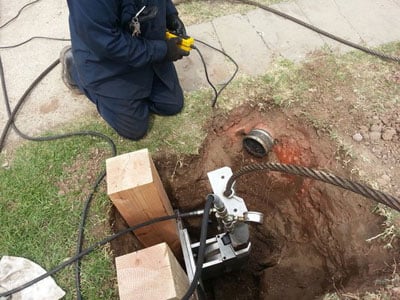
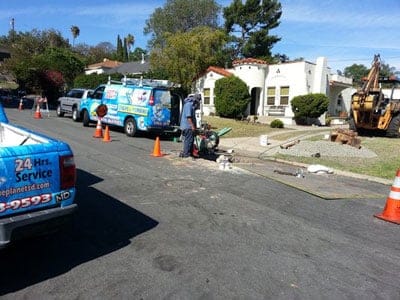
Pipe bursting pulls a continuous HDPE replacement through the existing line, fragmenting the host PVC or ABS outward. The advantage on Rancho San Diego properties: most of these homes have nicer landscape than older inland neighborhoods, and trenchless avoids tearing it up. Single-day work for most residential lateral replacements. On a typical Rancho San Diego job, the bursting head moves at roughly one foot per minute through soft soil, slower through rocky sections.

Sectional / Point Repair
Spot repair on a single belly or joint separation. Short CIPP sleeve over the damaged section, or a small open-pit repair. The camera shows whether one fix is enough. On a Rancho San Diego property, sectional repair often means saving thousands on a line that has 95% of its life left.
Sewer Camera Inspection First
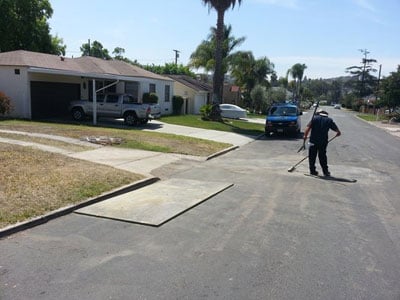
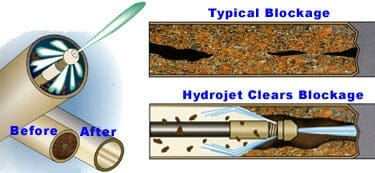
Camera inspection comes first. On Rancho San Diego lines we often see PVC-joint separation at one or two specific points, with the rest of the line in good shape. The inspection determines whether full replacement is warranted or whether a sectional repair will hold for another 20 years. We give you a copy of the Rancho San Diego camera footage either way — you keep it for your home’s records.
When Trenchless Beats Open-Trench in Rancho San Diego
Trenchless wins in Rancho San Diego because the original landscape on these 80s and 90s builds is mature now and worth preserving. The newer hardscape — pavers, stamped concrete, pool decks — is also worth keeping. Open-trench would damage all of it. Trenchless avoids the disturbance entirely.
Newer hardscape is the dominant factor. Rancho San Diego properties from the 1980s and 1990s often have nicer pavers, stamped concrete, and pool decks than older inland communities — restoration after open-trench would cost real money. Trenchless avoids it entirely. The two access pits are usually in soft ground at the cleanout and the property line, not through the hardscape itself. Trenchless also avoids most of the noise, dust, and traffic disruption that open-trench creates on a Rancho San Diego street.
What Trenchless Sewer Replacement Costs in Rancho San Diego
Trenchless sewer replacement in Rancho San Diego typically runs $4,500 to $12,000. Newer host pipe (PVC, ABS) bursts cleanly without the complications older clay or Transite can present, which keeps the average job cost moderate. Most residential work lands $5,500-$8,500. Larger commercial laterals scale higher; multi-unit properties under one parcel may qualify for a unit-rate discount across the entire job.
Add the avoided costs to the equation: no driveway demolition and re-pour (often $3,500-$8,000 alone on a typical residential driveway), no landscape replacement, no extended permit timelines, no waiting weeks for the front yard to recover. The total project cost story usually favors trenchless even when the per-foot price is similar to open-trench. We give you the full apples-to-apples breakdown in the written quote, including any optional add-ons like extended cleanout installation, code-required backflow valves, or a service warranty extension beyond the standard one-year workmanship coverage. Financing is available on most jobs over $3,000 with same-day approval. Most Rancho San Diego jobs are quoted same-day after the on-site camera inspection — no waiting on a third-party estimator, no surprise pricing later.
What to Expect on Trenchless Sewer Replacement Day in Rancho San Diego
Trenchless sewer replacement on a typical Rancho San Diego property follows a predictable timeline. Crew arrives early — usually 7 or 8 AM — sets up cone barriers around the work zone, and digs the two access pits (one at the cleanout, one at the property line near the city main). Pit excavation takes 2-3 hours depending on depth and soil. The bursting equipment is set up at the pull pit, the steel cable is threaded through the existing line, and the bursting head is attached at the entry pit. By mid-morning the actual replacement is underway.
Why Rancho San Diego Homeowners Choose Trenchless Sewer Replacement
Yes — that is the main reason customers choose trenchless. Two small access pits at the cleanout and property line. Everything between (lawn, plantings, pavers, stamped concrete) stays intact.
Rancho San Diego is unincorporated, so sewer-lateral work goes through County of San Diego Land Use & Environment Group. We file and handle inspections as part of the job.
A belly is a depression in the pipe where waste pools. Pipe bursting can re-grade the line if surrounding soil allows, but a true belly often needs open excavation at the bellied section to re-bed the pipe. Camera inspection tells us which approach fits.
Most covenanted HOAs require advance notification and proof of contractor insurance. We provide certificates and scope documentation. Some require the work be coordinated with their property manager for landscape restoration.
Yes, on most jobs over $3,000. Same-day approval available through financing partners, with 0% promotional terms for qualified applicants.
Yes for non-emergency jobs and inside an hour for genuine emergencies. Camera inspection slots are typically open within 2-3 days of the call. Once the camera confirms the right method, the actual replacement work is usually scheduled within the following week.