Skip to content

Trenchless Sewer Replacement in Alpine, CA
Alpine sits at 1,700 feet in the foothills east of El Cajon — larger lots, a mix of 1970s through current builds, and decomposed-granite soil that punishes anyone trying to run a backhoe through it. For homes on town sewer (mostly the older central Alpine corridor along Alpine Boulevard) trenchless replacement makes a hard job manageable. For lots on septic considering a switch, trenchless is also how the new lateral gets run from the house to a future hookup point without trenching the entire driveway. Free estimate, on-site walk-through, written quote — that is how every Alpine job starts.
Trenchless Sewer Replacement in Alpine, CA
Local Sewer Insight: Alpine
Alpine is a foothill East County community of about 15,000 where many homes sit on rocky, sloped terrain near Cleveland National Forest. Excavation here is difficult and expensive, so trenchless sewer replacement and lining are often the only practical, cost-effective way to restore a failing line.
Given Alpine’s rocky, sloped ground, trenchless lining and bursting spare homeowners the expense and disruption of blasting or hand-digging a long trench.
Trenchless Sewer Conditions Across Alpine
Alpine sits in the East County foothills near the edge of the Cleveland National Forest, and its rocky, sloped terrain makes it one of the hardest places in the region to dig. Decomposed granite and outcrops of solid rock lie close to the surface across much of the community, so an open trench for a failed sewer lateral often means breaking or blasting rock – slow, loud, and expensive. That single fact makes trenchless lining and pipe bursting the practical, cost-effective choice for most Alpine sewer replacements.
Many Alpine homes also sit on larger lots with long laterals running down sloped ground to the connection point, and a fair number of the community’s properties were on septic systems before connecting to sewer. Older clay and transition lines on terrain like this crack as the ground shifts and as roots from oaks and chaparral push toward the moisture. Pulling a smooth new pipe through the existing path from compact access points avoids both the rock and the slope work that make open-trenching here so painful.
Because excavation is so difficult in Alpine, an accurate diagnosis matters even more than usual – you do not want to dig the wrong spot in granite. We camera and locate the line first, then choose pipe bursting for a brittle line that needs a full upsize, cured-in-place lining where the host pipe can carry a liner, or a targeted spot repair for a single failed joint.
Areas of Alpine we serve: the Alpine Boulevard corridor, the Victoria and Rancho Palo Verde areas, the neighborhoods toward Harbison Canyon and Crest, and the rural-edge properties bordering the Cleveland National Forest.
In Alpine, watch for multiple slow drains, gurgling toilets, or a wet, foul patch over a long downhill lateral after rain. Because every dig here fights rock and grade, an early camera inspection is the single best way to keep a repair trenchless and avoid an expensive emergency excavation in the foothills.
Alpine sits around 1,800 feet of elevation near Viejas and the Descanso ranger district, and that mountain setting shapes local plumbing in ways the valley cities never deal with. Properties along Alpine Boulevard, Tavern Road, and South Grade Road often combine recent additions with original 1960s and 1970s construction, and a number of homes near Harbison Canyon and Crest converted from wells and leach fields within living memory. Fire-safe defensible-space landscaping, granite outcrops at shallow depth, and long downhill runs to the connection all push the choice firmly toward a no-dig solution.
The Alpine Historical Society keeps the town’s 1880s stage-stop roots alive, and that long history shows up underground as a patchwork of eras under a single street. Around Wright’s Field, the Joan MacQueen campus, and the Boulder Oaks stretch toward the casino, we have lined and burst everything from brittle 1960s clay to short transition stubs left over from a septic abandonment. Matching the right method to each segment is what keeps a foothill job affordable.
Padre Dam Municipal Water District serves much of Alpine, and the combination of district mains, private easements, and long shared driveways off Arnold Way and West Victoria can make a sewer connection point surprisingly far from the house. Add the occasional winter cold snap at this elevation and the seasonal load from places like Summers Past Farms and the Alpine Library corridor, and you get failure patterns we simply do not see down in the coastal flats. We map the full run with a locator first so an Alpine homeowner pays to fix the actual problem, not to explore the hillside.
Sewer Failure on Your Alpine, CA Property?
Alpine trenchless decisions hinge on lateral length — most properties here have 80-150 foot runs, where open-trench across rocky terrain would mean a multi-day excavation project. Trenchless sewer replacement covers four primary methods, plus camera inspection as the diagnostic step that determines which method fits a given line. The right call depends on what the camera shows: pipe material, severity of damage, line condition end-to-end, depth, and access constraints on the lot. The four methods below cover the realistic options for an Alpine residential lateral or a small commercial line. We walk you through which one is right for your specific situation as part of the on-site quote, including the trade-offs between methods on cost, longevity, and disruption.
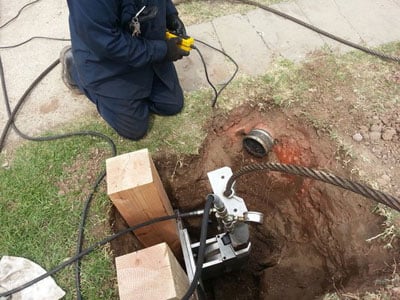
Pipe Bursting in Alpine, CA Sewer Replacement
Pipe bursting is the workhorse for Alpine sewer-line work — pulling a continuous HDPE replacement through the path of the failing line on a steel cable. The 50- to 100-year design life of fused HDPE matters more on rural-feeling Alpine lots where the next failure could be 30 feet under a long driveway you would not want to dig up twice. On a typical Alpine job, the bursting head moves at roughly one foot per minute through soft soil, slower through rocky sections.

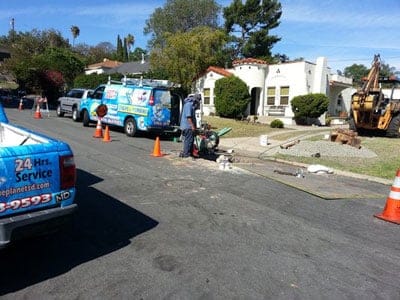
Point Repair on Alpine, CA Sewer Lines
Spot repair on Alpine lines often makes sense — long runs, with usually only one or two failure points. A short cured liner over the damaged section, or a small open-pit repair. The camera shows whether the rest of the line will hold for another decade. On an Alpine property, sectional repair often means saving thousands on a line that has 95% of its life left.
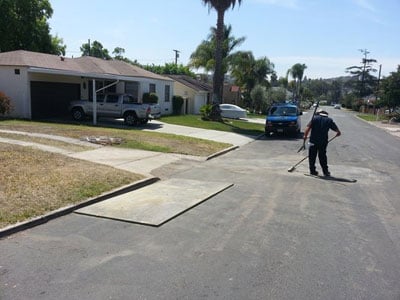
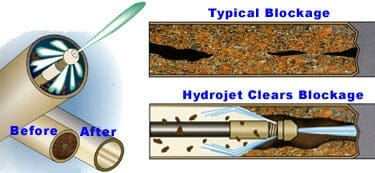
Camera Inspection Before Any Alpine, CA Trenchless Work
Camera inspection is critical before any Alpine trenchless quote — long lines, often through varied terrain, mean we need to know exactly what we are pulling through. The footage shows pipe condition end-to-end. We give you a copy of the Alpine camera footage either way — you keep it for your home’s records.
When Trenchless Beats Open-Trench in Alpine, CA
Trenchless wins on Alpine properties whenever the driveway is long, the soil is rocky, or there are oaks and other heritage trees worth keeping. Open-trench across 80 feet of decomposed granite is expensive; trenchless avoids it entirely. Open-trench still wins for very short, shallow runs on raw lots or when the existing line has multiple collapses.
Soil composition is the biggest factor. Alpine’s decomposed-granite and rocky-loam terrain means open-trench excavation runs into boulders and rock layers regularly — slowing the crew, breaking equipment, increasing costs. Trenchless follows the existing line path that was excavated through whatever obstacles the original installer hit, sidestepping the rock problem entirely. Trenchless also avoids most of the noise, dust, and traffic disruption that open-trench creates on an Alpine street.
What Trenchless Sewer Replacement Costs in Alpine, CA
Trenchless sewer replacement in Alpine typically runs $5,500 to $15,000. Longer runs (Alpine lots often have 80-150 feet of lateral) push the high end. Decomposed-granite soil makes the open-trench alternative even more expensive, which widens the trenchless cost advantage. Larger commercial laterals scale higher; multi-unit properties under one parcel may qualify for a unit-rate discount across the entire job.
What to Expect on Job Day in Alpine, CA
An Alpine trenchless day usually means a 30-minute drive out from the Chula Vista hub, with extra equipment for the rocky access pits common at higher elevations. Trenchless sewer replacement on a typical Alpine property follows a predictable timeline. Crew arrives early — usually 7 or 8 AM — sets up cone barriers around the work zone, and digs the two access pits (one at the cleanout, one at the property line near the city main). Pit excavation takes 2-3 hours depending on depth and soil. The bursting equipment is set up at the pull pit, the steel cable is threaded through the existing line, and the bursting head is attached at the entry pit. By mid-morning the actual replacement is underway.
Why Homeowners in Alpine, CA Choose Trenchless Sewer Replacement
Yes. Trenchless handles longer runs (100+ feet) more efficiently than open-trench. The pull cable goes through the existing line, and we add intermediate access pits if necessary.
Yes — that is one of the strongest cases for trenchless. Pipe bursting pulls the new HDPE under the driveway without disturbing it.
Yes. Sewer-lateral work tied to the Padre Dam district main requires permitting and inspection. We file the paperwork as part of the job.
Yes. We bring rock-rated equipment when the camera or pre-job survey shows hard soil at the access points. The pits themselves are small, so even rock conditions are manageable.
Camera inspection typically within 2-3 days of the call. Quote same-day after the camera. Work scheduled within 1-2 weeks for non-emergency jobs; same-week for active backups.
Yes for non-emergency jobs and inside an hour for genuine emergencies. Camera inspection slots are typically open within 2-3 days of the call. Once the camera confirms the right method, the actual replacement work is usually scheduled within the following week.