Skip to content

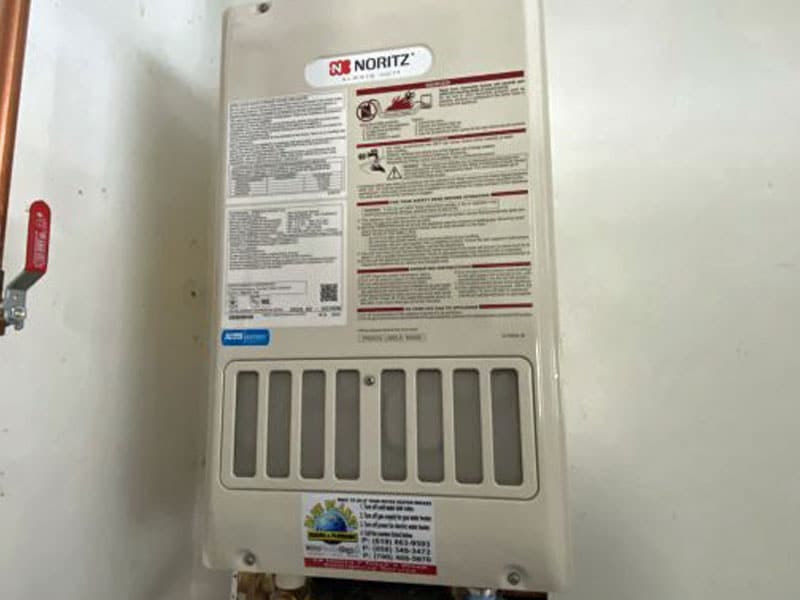
A tankless water heater conversion is one of the bigger plumbing decisions a San Diego homeowner makes. Done right, it cuts your utility bill, reclaims a closet, and gives you genuinely endless hot water for those long winter showers in Carlsbad or family dinners in Bonita. Done wrong, it’s an expensive headache that never delivers what the sales pitch promised. Here’s the straight breakdown of whether tankless makes sense for your house, your water, and your usage.
How Tankless Actually Works
A traditional water heater stores 40-50 gallons of hot water at all times, maintaining temperature 24/7 whether you’re using it or not. A tankless unit heats water on demand — cold water flows through a high-output gas burner or electric element, comes out hot, and the unit shuts off when you close the tap. No storage tank, no standby heat loss, no running out of hot water during back-to-back showers.
The Real Benefits (And Where the Sales Pitch Lies)
Honest version of the benefits:
- Endless hot water for sequential use — back-to-back showers, dishwasher running during a bath, etc.
- 20-30% lower water heating energy use for typical households per US Department of Energy data
- 15-20 year lifespan vs. 8-12 for a tank unit (with proper annual maintenance)
- Wall-mounted, reclaims floor space
- Lower long-term operating cost over the unit’s lifetime
Where sales pitches lie:
- “Instant” hot water is not the same as “fast” hot water — you still wait for hot water to travel from the unit to your fixture
- Simultaneous flow limits — running two showers + dishwasher exceeds many residential tankless units’ flow rate; you’ll get lukewarm water
- Payback period is often longer than salespeople claim — 7-12 years is typical for a straight retrofit
- Required maintenance is real — annual descaling is mandatory in hard-water areas like San Diego County, or warranty is void
The San Diego Hard Water Reality
San Diego County’s water is hard — typically 17-25 grains per gallon depending on which water district serves your address. That mineral content is the single biggest variable affecting tankless water heater lifespan. Calcium and magnesium build up inside the heat exchanger faster here than in most U.S. cities, and a clogged heat exchanger drops efficiency and eventually triggers shutdown errors.
The fix is annual professional descaling (vinegar flush through service valves) AND, ideally, a whole-house water softener installed before the tankless unit. Many SoCal homeowners pair their tankless install with a water softener for exactly this reason. The EPA’s drinking water guidance includes regional hardness data worth checking before the install.
Gas vs Electric Tankless in SoCal
Most San Diego retrofits go gas because most older homes already have a gas tank water heater. Gas tankless units handle higher flow rates and work better for whole-house applications. Electric tankless is cheaper to install but can only realistically handle 1-2 simultaneous fixtures in a SoCal home — fine for a guest house or addition, usually not enough for a full primary residence.
If you’re converting from a gas tank to a gas tankless, expect the install to require:
- Upgraded gas line (older 1/2″ line may need to go to 3/4″)
- New venting (PVC for condensing units, stainless steel for non-condensing)
- Service valves with isolation ports for future descaling
- Possibly an electrical outlet for the unit’s controls
- Permit + city inspection — required in all San Diego jurisdictions
Sizing the Unit for Your Home
Tankless units are sized by flow rate (gallons per minute, GPM) at a specific temperature rise. For a typical San Diego home with incoming water at 60-65°F and target output of 120°F (a 55-60°F rise), you need:
- 2 bathrooms, 1-3 people: 6-8 GPM unit
- 3 bathrooms, 3-4 people: 8-10 GPM unit
- 4+ bathrooms or families that run laundry + dishwasher + shower simultaneously: 10-12+ GPM or dual-unit setup
Undersizing is the most common mistake. Get the load calculation right or you’ll be cold-showered in the master bath every time the dishwasher runs.
When NOT to Switch to Tankless
- Your current tank water heater is less than 5 years old and working fine — payback math doesn’t add up yet
- You have a small household with low simultaneous demand — a quality tank unit may serve you fine
- Your home has very high hot water usage from a single fixture (long jacuzzi tub fills) — single-point demand can exceed tankless GPM
- You can’t or won’t commit to annual descaling — your unit won’t last and warranty will void
HVAC + Plumbing Coordination
A tankless install in an older home often surfaces other infrastructure questions: is the gas line adequate, is the venting path practical, where will the unit physically mount? Coordinating with an HVAC contractor early in the planning helps catch issues that aren’t visible during a quick plumbing estimate. For homeowners in markets where Blue Planet doesn’t operate, dedicated HVAC and ventilation services handle the work that often pairs with tankless installs, and out-of-area homeowners can find tankless conversion plumbing services in other regions for similar projects.
Your San Diego Tankless Water Heater Specialists
Blue Planet Drains & Plumbing installs and services tankless water heaters across San Diego County — Chula Vista, San Diego, Bonita, Coronado, La Jolla, Del Mar, Carlsbad, Oceanside, Poway, and surrounding communities. Our tankless water heater service includes the load calculation, gas line assessment, permit coordination, and annual descaling that protects your investment in San Diego’s hard water. Contact us for a free in-home estimate before you sign off on a tankless conversion.