Skip to content

Gas leak detection and repair
Gas Leak Detection and Repair in San Diego, CA
We trace the smell to the line, prove where it is leaking, and repair or replace the section that failed.
If you can smell gas, leave the building and call the gas utility first — that call is free and it comes before anything else. Once the supply is safe, Blue Planet Plumbing finds the leak and repairs it. We pressure-test the system, walk the run with a combustible gas detector, isolate the failed section and put the line back into service, on residential and commercial gas piping across San Diego County.
How a gas leak is actually located
A gas smell tells you there is a leak. It does not tell you where. Gas travels along the outside of a pipe, through a wall cavity and out at a vent or a gap in the framing, so the place you smell it is very often not the place it is escaping.
So we work from the system, not the smell. The line is isolated and pressure-tested; if it holds, the leak is downstream of the test point and we move the isolation. If it drops, we have the section. From there a combustible gas detector walks the run — joints, unions, drops to appliances, the meter riser and any buried section — until the reading spikes.
On buried or slabbed lines we bar-hole along the route and test each hole, because the escape point at the surface can be metres from the break in the pipe.

Where gas leaks usually turn up
Threaded joints are the classic. Pipe dope dries out, the joint moves with thermal cycling, and it starts weeping — normally slow enough that you smell it long before any gauge would show it.
Appliance connectors are second. A flexible connector behind a range or a dryer gets kinked, crushed against the wall or fatigued when the appliance is pulled out for cleaning, and it fails at the bend. Our project log includes dryer gas line work in Rolando Village and gas pipe leak repair in Imperial Beach that both started exactly this way.
Third is corrosion on buried or exterior steel, which is why gas leak detection and gas line replacement so often end up as the same visit. We have run that job in La Mesa, Lakeside, Poway and Lemon Grove.
Repairing the line once the leak is found
A single failed joint or connector is a repair: cut it out, remake it, pressure-test the section and prove it holds before the gas goes back on. That is the outcome we want, and on a modern system it is usually the outcome we get.
Where the pipe itself has corroded through, replacing the run is the honest answer — patching one hole in a line that is rusting along its whole length just moves the next call a few months down the road. For those, see our gas line repiping page.
Every repair finishes the same way: the system is pressure-tested again, appliances are relit and checked, and nothing is left open.
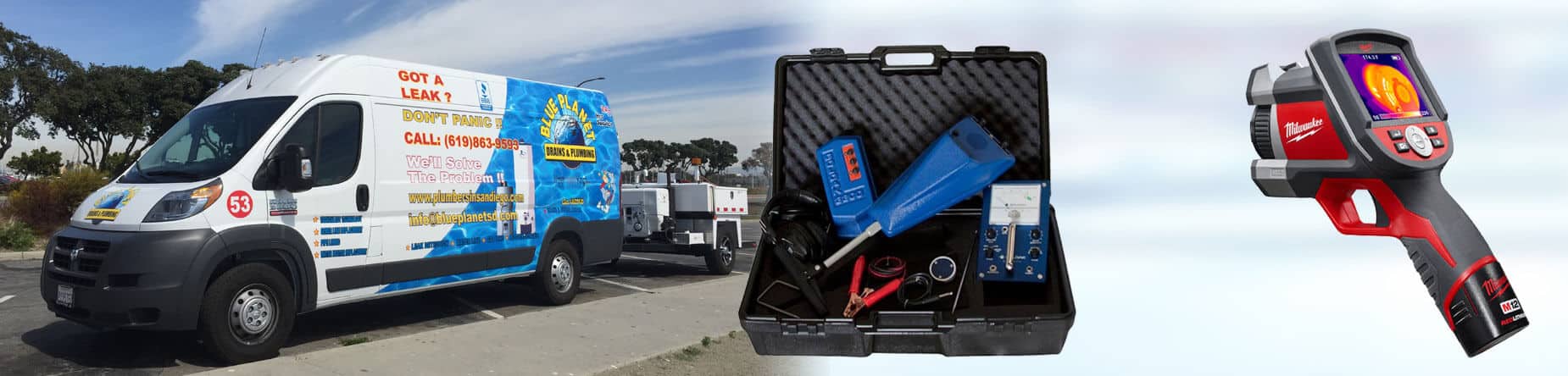
Commercial gas lines
Commercial work adds two things: more appliances on one manifold, and a shutdown that costs money. We isolate by branch so the rest of the kitchen or plant can keep running while the failed leg is repaired, and we schedule the pressure test around service hours where we can.
We have carried out commercial gas leak repair in San Diego and gas main line replacement in La Mesa. Our commercial plumbing page covers the wider commercial service.
What we will not do on a gas call
We will not guess. Excavating where the smell is strongest, before the line has been pressure-tested and walked with a detector, is how a driveway gets opened in the wrong place and the leak is still there afterwards.
We will not relight appliances on a system that has not passed a pressure test. If the section will not hold, it stays isolated until it does, whatever that means for the schedule.
And we will not patch a run that has corroded along its length just because a patch is quicker. If the pipe has failed as a pipe, the right answer is replacing that run, and we would rather tell you that on the first visit than on the third.
What we check on a gas leak call
| What we check | What it tells us | What happens next |
|---|---|---|
| Pressure test on the isolated line | Whether the system holds at all | Narrow the isolation until the failing section is found |
| Combustible gas detector along the run | Which joint or fitting is releasing | Mark the point and expose it |
| Appliance flexible connectors | Kinks, crushing and fatigue at the bends | Replace the connector and re-test |
| Threaded joints and unions | Dried compound, movement, weeping | Cut out and remake the joint |
| Meter riser and exterior steel | Surface corrosion and pitting | Repair, or price a replacement run |
| Bar-hole testing over buried line | Where along the route the gas is escaping | Excavate at the reading, not at the smell |
| Re-test and appliance relight | That the repair actually holds | Sign the system back into service |
Gas leak FAQs
I can smell gas — what should I do first?
Get everyone out, leave the door open, do not touch light switches or anything that can spark, and call the gas utility from outside. They will make the supply safe at no charge. Call us once that is done and the line needs finding and repairing.
Can you find a leak if there is no smell?
Yes. A pressure test will show a system losing gas whether or not anybody can smell it, and a combustible gas detector will pick up concentrations well below the level a person notices. If you have a high bill and no smell, that is the test to run.
Why is the leak not where I can smell it?
Gas follows the outside of the pipe and the path of least resistance through a wall or a trench, then comes out wherever it finds a gap. That is why we locate by pressure-testing sections and walking the run with a detector rather than digging where the smell is strongest.
Do you repair the line or just find the leak?
Both. Finding it is the first half of the job. We cut out and remake failed joints, replace appliance connectors, and where the pipe itself has corroded we price replacing the run rather than patching it.
Do you work on buried gas lines?
Yes. Buried and slabbed lines are located by bar-holing along the route and testing each hole, so the excavation happens at the actual break rather than at the point where the gas surfaces.
Can you do this on a commercial kitchen?
Yes. We isolate by branch so the whole site does not have to shut down, and we work the pressure test around service hours where the schedule allows.
Related pages: gas line repiping, pipe repair, leak detection, emergency plumbing services and commercial plumbing.
Get the leak found and repaired
Once the utility has made the supply safe, we take it from there — test, locate, repair and prove it holds.